
As the AI (and Robotics) bandwagon starts impacting everyday life, an interesting issue facing all humanity across different economic value chains is – How do I “protect” myself from the collateral damage of AI adoption at scale? Here we focus on a much narrower notion of “protecting one-self” – how do I secure my existing job, plan for a future one or transition to a new role related to AI. The recent labor and impact surveys highlight the importance of this issue. One of the solutions being proposed to each such aspirant is to “become a generalist” – especially with respect to folks getting into colleges and those already part of the workforce. What does becoming a generalist entail? What does this even mean? How do different folks at different stages of their careers become a generalist? Is becoming a generalist a good thing or bad thing? This essay outlines some points of view around this and hopefully provides some pointers to everyone who thinks they need to get prepared for the upcoming changes.
Understanding Knowledge and Skills
Before we get into the weeds, let us review some basic terminology that is essential for the ensuing discussion – Firstly, What is knowledge? Knowledge is the familiarity, awareness, or understanding of facts, information, or skills acquired through experience or education. It involves interpreting, analyzing, and applying information to create a coherent understanding, often defined in philosophy as justified true belief. It is categorized as knowing that (facts), how (skills), or by acquaintance. What is a skill? A skill is the learned, proficient ability to bring about predetermined results through actions, typically acquired through training, practice, or experience. It involves applying knowledge to effectively execute tasks, often categorized into soft skills (interpersonal) and hard skills (technical). Examples include communication, coding, project management, and carpentry. Both – knowledge and skills are being “automated” – either as software or hardware or a combination of both. Both knowledge and skills are “physical” and digital – helping one navigate and interact with the physical (walking) and digital worlds (browsing the web). Also – knowledge and skills in different areas are explicit (preparing a power point deck) or implicit/tacit (emotional assessment in an interview). These are also unstructured or structured. They are also “internal” (to the human, such as cycling) or externally codified and shared across a community (doing yoga). Both knowledge and skills vary by geography and culture. So now given this landscape of knowledge and skills – what can be automated – physically or digitally (as a robot or as an AI system)?
Things that are structured – laid out as a standard – it could be the description of a thing or rules about a thing or it could be the description of a process such as a recipe or a standard way of physically interacting with the world etc – are prime targets for physical or digital automation. Though this is well known across knowledge domains, an open question is – why has it suddenly become feasible to automate this “structured” knowledge (skills will be discussed below)? Two key reasons are driving this – 1) All modern knowledge is organized and structured in the same manner across all domains – natural sciences and the social sciences. It is also approved, disseminated, evaluated and applied in the same manner. The modern knowledge management lifecycle – discovery, acquisition, evaluation, assimilation phases are pretty much standard. 2) All the knowledge is objectively “encoded”/represented as externalized “textual” knowledge (we include – formalisms, charts, graphs, images, videos etc within the same rubric). So once you understand the overall process behind the knowledge lifecycle – it is automatable. This is what the modern LLMs are doing – Gemini, Claude and the rest. However, a key bottleneck to automation is the availability of training data. Knowledge domains which have enough textual content with all its variations – such as “documented” knowledge, standardized approaches to procedures etc – are all amenable for assimilation by AI systems – which is what we are seeing as the foundational model companies go vertical. Tacit knowledge applications still require a human in the loop.
We have not reached a similar level of “felicity” with skills – especially physical world skills, tacit skills and more. Our AI models and robots do not understand the physical world very well yet (research is underway to capture this world) and the robot/humanoids being built still operate by learning from simulations of human activity. For example – folding clothes – videos of humans folding clothes are used for training manipulator robots to automate the folding of clothes. (I am yet to see a humanoid robot fold an Indian dhoti or saree). Although one can design a different kind of machine to fold dhotis – as seen in textile companies.
Understanding the Knowledge Lifecycle
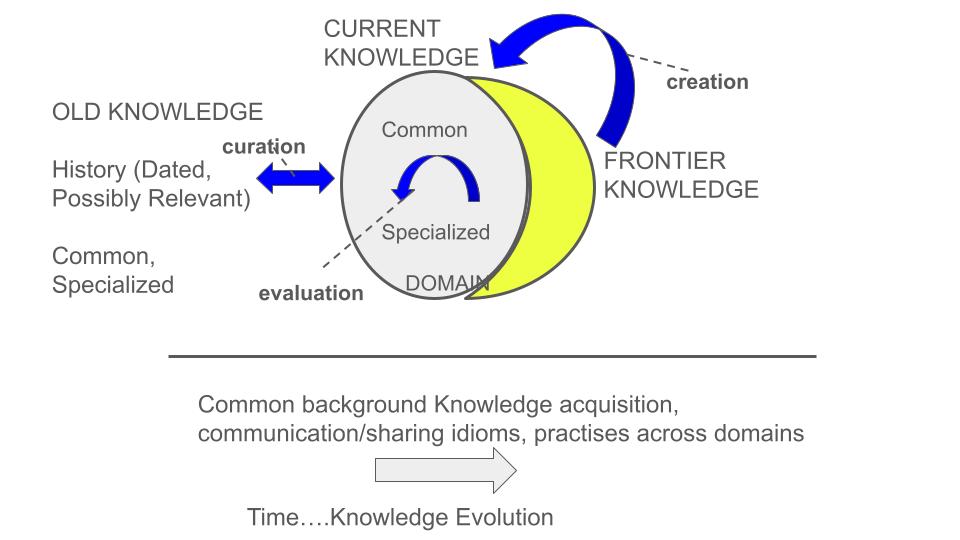
The above graphic provides a view of the knowledge management lifecycle at any given point in time – in any given domain. In the graphic above, we illustrate how knowledge evolves in a domain. There are three buckets of knowledge for a given domain – Frontier knowledge, Current knowledge and Old Knowledge. All buckets of knowledge can be classified into two major sub groups – Common knowledge and specialized knowledge. For example – consider the subject of Physics – a science school teacher is familiar with basic concepts of physics that he/she shares with their students – common knowledge – whereas a Particle Physics Researcher focuses on specialized knowledge on particles that make up the cosmos. The boundary between common and specialized may be fuzzy but there is a tacit understanding of this divide in almost all domains. Now the most important thing to note is – What are the LLM’s capturing in any domain? – All the common knowledge curated from old knowledge, and all the common knowledge from the current knowledge bucket. They currently do not capture anything yet about the frontier knowledge bucket. Training datasets in each domain address what should be commonly known in that domain. Ingestion of Specialized knowledge from domains at scale is still under-research because of the limitations of scale of training date and some fundamental technological limitations of LLMs. The purple arrows illustrate the knowledge update process in each knowledge bucket. Frontier knowledge once discovered/validated gets assimilated into current knowledge. Current knowledge evolves continously as it is understood better, applied in different real world scenarios as it transitions from common to specialized and back. Old knowledge considered irrelevant is discarded and relevant aspects are curated for current use in a domain. For capturing knowledge in any domain, a basic set of “knowledge” and skills is required along with basic comprehension, literacy and communication skills. The basic knowledge and skills is what the K-12 education systems aims to provide to all humanity.
Given the above schematic on the knowledge lifecycle – few observations come to mind –
a) Frontier knowledge management is currently beyond AI systems and needs humans in the loop.
b) Specialized current knowledge management, including setting objectives for frontier knowledge acquisition requires humans in the loop.
c) Identify and curating what is relevant and what is not from the old knowledge bucket requires humans in the loop.
d) Maintaining all these knowledge buckets requires human judgement and governance.
All other knowledge buckets are amenable for “ingestion” by an LLM. Anyone operating in these buckets will be impacted by the world of LLMs first in the near future.
Generalist versus Specialist
Now given the above landscape on knowledge and skills – a specialist (in the modern sense) is one who is an expert on structure of knowledge/skills in a given domain. They understand the full lifecycle of knowledge management in a given domain and are at the frontiers of the domain creating new knowledge, curating old knowledge etc. To be a specialist at the top of their game – they need to know the theory and practice of the subject matter. One without the other limits an experts view. It takes years of practice and focus to reach this level of specialization. Most of us everyday folks are at the 50%-60% level of specialization if not less in any domain after about two decades of work in a domain.
A generalist on the other hand – does not go deep into any domain – but understands the knowledge lifecycle to some extent in a loose manner and operates on the fringes of a domain. They feed the knowledge lifecycle from multiple perspectives – disseminating knowledge, applying knowledge, utilizing knowledge, evaluating knowledge etc. by working with specialists in a domain or a set of domains.
Being a Specialist – What can you do now?
A “specialist” in any domain has a key role to play in the evolution of “AI” in that domain. Specialists can help “build” the AI system by structuring/sharing their knowledge for learning. creating training data sets, evaluating the AI system performance etc. They can extend the “capabilities” of the underlying system. Structure the unstructured and possibly feed into a system for automation.
Additionally, a specialist can work on the “frontiers” – creating new knowledge – a process that is nearly fully human. They can also identify aspects of the frontiers where more research is required to understand the physical world and drive the research and also finally draw boundaries and identify what is not worth automating and the reasons why. Specialists can also drive the specialized/common knowledge distillation processes in the other two knowledge buckets.
Finally, specialists can also transition into reliable generalists as they pick up adjacent domains – since they are all “similarly” structured as mentioned earlier. The learning cycle is faster and they can support the AI enablement phase in these adjacent domains. Being a specialist first and then a generalist may be a good way to organize your career.
Being a Generalist – What can you do now?
The primary role of a “generalist” is to be the “eyes/ears” of an AI/Robotics system in the realworld. Most generalist will “map and verify” the LLM’s inputs and outputs while training and also possibly in the human-in-the-loop lifecycle while in operation. Most generalists will enable the future development of the AI system/robots in the physical worlds – enabling what is called “common-sense” reasoning and skills. This is possible for every human being – all the “different” perceptory and manipulatory abilities of a human being in different contexts will be utilized to tune the AI systems.
Additionally many current software/hardware systems in different domains are necessarily incomplete and in a constant state of evolution to fulfill new requirements or adapt to new component technologies. Adapting these systems to modern AI or viewing these systems from a clean-sheet perspective would require generalists without any pre-conceived notions -an interesting greenfield opportunity. Additionally, many systems developed in the past but discarded due to economic reasons may become viable again. Much exploratory and discovery work is required here across domains.
How to AI-Proof your career
Given the above discussion, there are are a few solid ways to AI proof your careers. Current career roles and organizational structure will evolve rapidly to accomodate the effects of AI/Robotics systems. An essential aspect is to introspect to know if you are a specialist or a generalist. Even if you are currently a specialist – what makes you a specialist ? Is that knowledge/skill going to be relevant in the future? can it be automated away? (This is what a lot of software engineers are currently facing with Coding agents) If you are a specialist, one has reasonably a longer runway to figure things out, as there are fewer specialists in any domain compared to generalists.
Given the knowledge evolution process above – specialists – can focus on the following.
- The structure of specialized “theoretical” knowledge is similar across knowledge domains. So go deep in your domain – understand the knowledge structure and the processes that maintain this knowledge etc. Stay on the bleeding edge.
- Similarly, the structure of “physical/motor” knowledge is also similar – we all have a similar level of physiological structure and human capabilities etc – so depending on your current career role – focus on what future automation would require. You can train motion “simulators” to train robots for example.
- Most complex are domains where both the physical and the theoretical knowledge interplay – this requires acquiring training for skills and expertise. Consider for example, can everyone who chops vegetables (as a sous chef in training) in a restaurant become a skilled surgeon – both involve “cutting” – but in very different contexts.
Generalists on the other hand will have a much harder time – basic reading, writing, comprehension driven activities or physical skill based career roles will be disintermediated. So what can one do? One can transition to an ongoing role in the automation lifecycle discussed above such as “scenario evaluator”, “perception checker” etc. or pick something to “specialize in” or focus on an activity where “economics of deploying automation” do not make sense.
Depending on the phase of your life – different options may be available –
- Going to undergrad/grad – most flexible – can focus on being a specialist and plan a career. 80% of domain knowledge to be automated may still take a couple of decades. Areas such as law, social sciences, medicine, R&D, engineering still require human expertise to “manage, prompt and eval” the AI systems. However, even conventional academia may be disrupted in the next decade or so and a different form of undergraduate education may emerge. Graduate studies may require a deeper commitment and in-depth study of the domain to push the AI envelope or focus on the knowledge creation aspect in a domain.
- Already working – currently mid-career in a role – figure out if you are a specialist or generalist. If specialist, move towards the knowledge creation/knowledge maintenance aspect. If a generalist, move towards the generalist activities discussed above or launch your own entrepreneurial effort pushing the AI envelope in some domain of interest.
- Retirement phase – your experience in a domain is invaluable. Lots of foundational and contextual knowledge needs to be captured and utilized in concert with an AI system. Much of this may be re-discovered again as AI systems get deployed in the realworld. The common knowledge may be ingested by an AI system but the how-to-use and apply this knowledge is a big missing piece.
- Non-educated blue-collar worker – what should you do? – transition to a generalist role.
Concluding Remarks
The above discussion outlines one way to think about how to cope with the impact of AI on jobs, careers and the notion of employment. An alternate view is discussed here. Many effects and changes are yet to be understood. Even the current capitalistic model of the economy may change in the age of “abundance” and potential universal basic income. We have not even considered the role of regulation and societal pushback against AI from different perspectives.
The essay rests on understanding the knowledge lifecycle in a civilization. Many open questions exist requiring answers, such as:
a) Given the current human population of about 8 Billion – how many people are involved in the above knowledge management process on a daily basis? Should everybody be involved in this? Why/why not?
b) How old is the above “repository” of human knowledge? How much is specialized and how much is general? How much of all this knowledge has been ingested in an LLM? A recent talk at CMU suggests that the LLM should be viewed as a polymath – an interesting perspective. Question is how do you differentiate a good polymath from a bad one?
c) In the above knowledge framework – how much of the worlds knowledge is covered? Does it cover all different types of knowledge from different cultures?
d) Is all the knowledge covered by the above framework – really true and reliable? Is it really complete? Who covers the last mile for the knowledge to be useful and effective?
Thus far, “knowledge” was considered the defining factor in one civilization being better than another and also a marker of cultural evolution. This whole framework has come up for review now. However, as the age of AI rolls along, many changes will come about, some good, some bad but hopefully human ingenuity helps us cope with these changes. We are still in the early days of AI/Robotics as they go mainstream and I believe we have enough time ahead as a society to figure out what to do next.
Update:
July 15 2026 – A keynote talk at ICML reflecting a similar thesis. Additionally Microsoft CEO Satya Nadella’s talk also underscores the types of knowledge and IP to share or not share.