
Intellectual property management involves handling the full lifecycle of managing knowledge assets – both digital and physical, from identifying new innovations to managing licensing, commercialization, infringement monitoring and enforcement. The current philosophy of intellectual property (IP) management balances an innovator’s moral and financial right to their creations with society’s need for access to knowledge and continued innovation. It treats intangible assets (patents, copyrights, trademarks) as strategic tools for competitive advantage, compliance, and growth in modern capitalism. In this age of AI – where common knowledge – has been used to train a variety of AI systems, a major question to be addressed by enterprises – startups, big and small is – should I file for “patents” to protect my assets? Investors need to ask is there economic value in protecting the startups knowledge assets? To obtain a patent, one has to fully disclose the invention – atleast the key ideas underpinning the innovation. This disclosure is public and LLMs can ingest the same disclosure document under fair-use doctrines. The key ideas in that invention may show up in so many future LLM-driven invention/discovery scenarios disseminated globally. How can the inventor’s really identify infringement, protect or gain economic benefit in a fair manner? In this essay, we briefly analyze this scenario and suggest that patenting and disclosing inventions may *not* be such a good idea in this age of AI – if you intended it primarily for economic gain. The overall premise of this essay is “Knowledge disclosure of any kind is risky” and especially more verified the “knowledge”, the more valuable it is.
To substantiate this position, we need to first understand how “knowledge” is created and managed. Knowledge assets include both digital and physical artifacts. An overview of how knowledge is created and managed is discussed in this related article. Key takeaway – anything standardized as a process, entity, physical or digital is ready for being ingested by an AI system. Real value lies on the frontier of knowledge in a domain. Does one need to disclose it to get the patent rights to harvest its economic value? In this age of fast innovation, and fail-fast technology development and deployment mentality, it is unclear that getting a patent that outlines the frontier in that domain is worth the risk.
Any disclosure defines the “search space on the frontier” – all adjacencies are exposed – various abstractions and more. A reasonably qualified expert in that domain can recreate a range of adjacent configurations that mimic the “patent” – without actually violating the claims of a patent. Point being in a complex search space, there are many paths to the same goal or objective. Cost of “generate” and test is way down. Simulation-based testing costs have come down considerably with reduction in compute costs. Physical testing costs are also on the way down with advances in automation and robotics. However, a human in the loop to understand the test results and suggest the next stage of exploration is still a choke point. However, overall costs of exploration are down. Disclosure of any kind defines the “search space” which is the costly effort. A good article to understand the nature of the innovation search space especially in the context of “discovery via AI” is discussed here.
If oil was found in one set of conditions, it is easy to extrapolate and search for oil in “similar” conditions such as in petroleum exploration. Getting all or most of the parameters correct for estimating similarity is the most difficult part which can then be tweaked to accomodate possibly local contextual parameters. Large parameter spaces can be searched easily, once the “problem abstraction” space is well defined. As math models improve in “fidelity”, the cost of physical validation via observation comes down considerably – reducing overall costs. We believe – IP disclosures – define this search space and with the speed of discovery – legal protection for ideas and more – seems to be on thin ice. Key advantage is the speed of innovation and market building rather than IP protection per se.
Many of the concerns outlined above is reflected in the evolution of the AI stack. Foundational model companies are evolving into vertical players as they “standardize/automate” domains. Where are the barriers in a given domain is something to think about as a founder or even AI adopter. An interesting question to consider is the following session I had with one of foundation models –
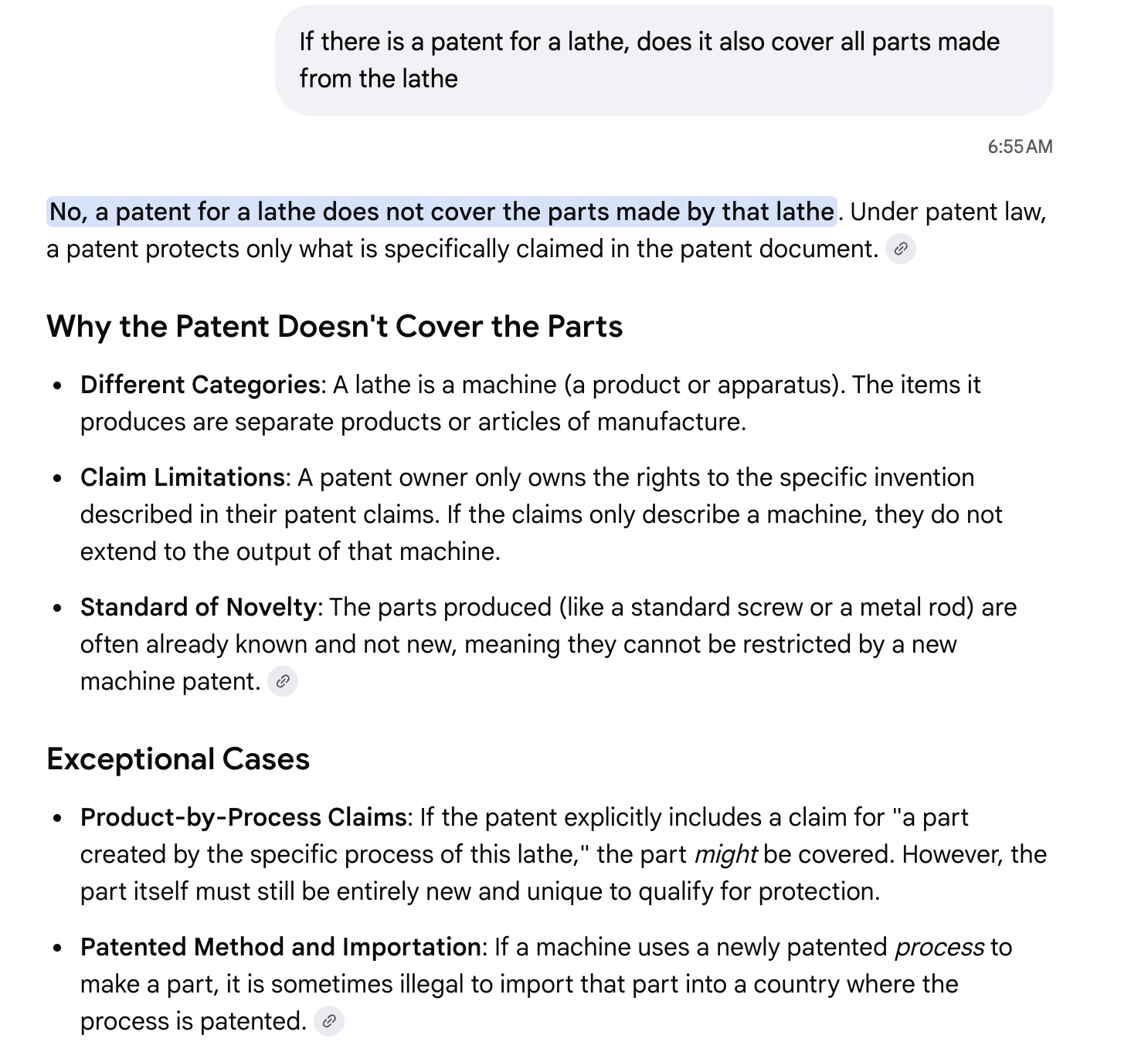
So in the current AI age – Is the LLM a “lathe” or something more? What are the boundaries of “knowledge” products unlike physical products? How does one draw the boundaries? In this milieu, what should a start up do? If you are on the frontier and you are discovering or building new stuff, the moment you disclose, your advantage will be lost much faster than you estimate. Protecting the knowledge is important till you get your marketshare! Let your competitors spend their resources on the generate and test search process! Anyways, overall IP protection frameworks have a long way to evolve before they can offer any meaningful protection. As a startup founder, it may be better to play it safe till you build your moat and have enough resources to sustain it.
Update July 14 2026
A similar sentiment with a couple of more nuances discussed by Satya Nadella on X. Also, an article on the “ethics” of using somebody else’s Intellectual Property in the age of AI.